Tuesday, 17 June 2014

KENYA OUT AND ABOUT GUIDE


JAMBO MOMBASA
Get to know the sights of Kenya’s second city on this introductory tour. You’ll get to see the best bits of the town, from the Portuguese-style Fort Jesus to its beautiful old quarter. Put all your African preconceptions on hold. We’re talking twisting alleyways, elaborately carved doors and overhanging balconies. You’ll make your way to the carnival that is Mombasa Market – think spices, woodcarvings and batik fabrics. Lunch is usually served onboard the Tamarind Dhow, famous for its mouthwatering steaks, seafood and the Dawa house cocktail – a tasty concoction of vodka, lime, honey and sugar. Round off the day with an afternoon at the Haller Wildlife Park. This private game reserve is home to crocodiles, snakes, hippos, giraffe and giant tortoises. This full day trip encompasses history, culture and wildlife so it really gives you a taste of everything Mombasa has to offer – all in a day!


REAL AFRICA – ECO TOUR
The name of this trip says it all! This is your chance to experience the 'real Africa' as you venture out into the countryside to learn all about the locals and their way of life. You will visit rural villages and meet the indigenous Kenyan people who will show you first-hand the different aspects of their culture. Religion, art and craft, medicine, agriculture and education are all included and you will be fascinated at every stop. But this is about more than just the local tribes, after a delicious Swahili lunch, a visit to the Ngomongo Villages will give you an ethnological tour of the entire country. Meet members of the various tribes and visit their homesteads, you can even join in with some of their cultural activities. This is an excellent opportunity to share out any gifts you may have bought with you such as pens, pencils, books etc

SHIMBA HILLS
Set in the heart of Kenya’s tropical rainforest, Shimba Hills is one of the country’s best-preserved game retreats. Its rolling grasslands and thick forests are home to all creatures great and small, including over 500 elephants. But it’s the Sable antelope which makes visitors flock here – it’s exclusive to Shimba Hills so keep your eyes peeled. The trip includes a night at the impressive Shimba Hills Lodge. With its open-fronted restaurant and elevated walkway which extends into the forest, it brings you really close to the nature. Spend the evening relaxing in the bar before falling asleep to the song of bush babies and croaking frogs. This is one experience you won’t want to miss.


OVERNIGHT ARUBA
This one gives you three game drives  to explore Kenya’s largest game park, Tsavo East. Covering more than 20,000 square kilometres, it’s bigger than Wales. Here, you can enjoy the company of lions, leopards and cheetahs, and tick off over 500 species of bird. But a park this size has a lot more going for it than just wildlife. This is classic African savannah grassland with endless sweeping plains that are brilliantly photogenic. In the evening, check into the Ashnil Aruba Lodge for a chance to unwind and do some animal-watching by night. This spacious lodge is located by the Aruba dam which attracts elephants and buffalos, you’re likely to get a front-row seat.


TSAVO AND SALTLICK
Leave the bright lights of the city behind and get back to nature on this two-day safari. With visits to both Tsavo East National Park and Taita Hills Sanctuary, you’ll be spoilt for choice when it comes to game drives and scenic trails. Look out for lions, giraffes and buffalos, as well as native red elephants which take their name from the russet soil they roll in. As well as all this, you’ll also enjoy a night of luxury in one of Kenya’s most unusual hotels. The rooms at Saltlick Lodge are raised on stilts and the bar and restaurant overlook the lodge’s very own spot-lit watering hole, so the animal-watching can continue well after the sun goes down. The elephants come so close here that you can almost reach out and touch them! It’s ideal introduction to the ‘safari’ experience.


MASAI MARA SAFARIS
Very few places are able to dazzle safari veterans, travel writers, documentary makers and film researchers time and again, But the Masai Mara National Reserve is one of them. This is one of the best places on earth to see animals in their natural habitat, why else would the BBC choose this as the location for their ‘Big Cat Diaries’? So what is it that makes this park so special? Well, not only is it home to an abundance of wildlife – think lions, cheetahs, rhinos and crocodiles – the scenery’s beautiful too. Open savannahs stretch into the horizon and sprawling grasslands lie side-by-side with natural pools of water. But it’s the annual wildebeest migration that has really put this place on the map. Every summer, hundreds of thousands of the horned beasts make the long trek from Tanzania’s Serengeti Plains to Masai Mara, in search of sweet grass to feast upon. The sight of them wading across the Mara River in their hundreds will stay with you forever. We have a number of different trips to choose from, so there’s bound to be something that’s right for you.
The accommodation in the Masai Mara can also be a highlight in itself and we have a range of potions to suit your needs. Please don’t delay in speaking to your holiday advisor who will be on hand to help you make that informed choice.


BALLOON SAFARI (available as an add on to Masai Mara safaris)
If you want holiday memories that’ll last a lifetime, book a place on our balloon safari over the Masai Mara. Feel the wind in your hair as you glide across the skies, while herds of animals graze below you. Magical.

TAILOR-MADE SAFARIS
One of the best things about being on holiday is having the freedom to do what you want, when you want – and we’re here to help with that. So if there’s a particular park you’d like to visit or a specific animal you want to see, speak to your Holiday Advisor about arranging a tailor-made safari.

SWAHILI BLUE
Are you ready folks? It's time to set sail on the 'Rolls Royce' of dhow boats - our very own 'Swahili Blue'. From the moment you step on board you will be pampered by our attentive and welcoming crew who will ensure that you have a day to remember. We will head to out sea to spot the many dolphins that call the Pemba Channel their home, the photo opportunities can be outstanding! If you fancy seeing what's under the surface of the crystal clear waters then our experienced crew offer you the opportunity to do just that with all snorkelling equipment provided. You can even try your hand at a spot of scuba diving for a small extra charge. Lunch is taken at an exclusive island restaurant where a culinary feast of local specialities await you, what ever your palate.... After time to relax and chill by the unique pool, or explore the mangroves and boardwalk, it's time to sail back towards home. As if this wasn't enough, this all inclusive day also helps the local community so why not come and join us?


TAMARIND DHOW
Step onboard Mombasa’s most famous floating restaurant, and watch the sun set as you sail down Tudor Creek. The restaurant is renowned for its steak and seafood, and you’ll be able to try a little bit of everything in a five-course dinner. But it’s not just the food that’ll make this an unforgettable night – the atmosphere and the views are incredible, too. As the boat slips away from the jetty, put on your dancing shoes and move to the smooth sounds of the resident band. As you sail past the moonlit Fort Jesus and Mombasa’s old town, you’ll agree this a dining experience with a difference.


FORT JESUS BY NIGHT
What better way to kick off an evening than by sailing into the sunset on a dhow, cocktail in hand? Enjoy the views as the boat makes its way to Mombasa’s most popular attraction – Fort Jesus. Built in the 16th century to guard the old port, it’s surprisingly well-preserved. After a short, guided stroll through the old town, you can learn about its turbulent past by watching the ‘sound and light’ show. Then pull up a chair within the walls of the fort for a five course meal. With great food and service and candlelight throwing shadows on the walls, this will be one dinner you won’t forget.


TSAVO EAST AND WEST
A special two-night taste of both parks. Stay at Ashnil Aruba Lodge, overlooking the Aruba dam and boasting a location in the heart of the park. Your second night will be spent at the luxurious Severin Safari Camp where you have the best chance of spotting a hippo or two as you unwind, drink in hand, soaking up the safari atmosphere. Tsavo is the largest park in Kenya, the East is dry and barren whilst the West is more green and fertile, a complete contrast on this great safari. With a good chance of spotting the 'big five', numerous other animals, colourful birds and some amazing scenery along the way. One of our most popular safaris and great value too.


DHOW ADVENTURE
This is the original Dhow trip and still as good today as when it started 25 years ago. Loads of fun aboard a traditional Arabic Dhow. There's a chance to catch some sun and snorkel giving you the opportunity to discover the underwater wildlife treasures of the Indian Ocean. For those who prefer to stay dry there is the option of visiting the ruins of an ancient Swahili settlement, the choice is yours. Enjoy an delicious BBQ lunch, taken in the picturesque cool riverside restaurant. Don't worry though, if your tastes are not so adventurous there's plenty of choice, but where else can you say you had a crocodile kebab! In the afternoon we set off again and cruise up the river, while guests are entertained with a troop of acrobats, musicians and even a fashion show.


CHAMPAGNE CRUISE

Eat, drink and soak up some rays VIP-style on this luxurious adult-themed cruise. You’ll sail to an exclusive sandbar where you’ll be met by waiters and showered with champagne and oysters. At lunch time, tuck into a magnificent 15-course seafood platter. With giant prawns and fresh lobster on the menu, this is a meal fit for a king and the champagne is still flowing! After this leisurely feast the mood is exceptionally chilled, so it’s back on the dhow to cruise up the creek as the sun sets behind the distant hills….

Thursday, 12 June 2014

Leopards are graceful and powerful big cats closely related to lions, tigers, and jaguars. They live in sub-Saharan Africa, northeast Africa, Central Asia, India, and China. However, many of their populations are endangered, especially outside of Africa

The leopard is so strong and comfortable in trees that it often hauls its kills into the branches. By dragging the bodies of large animals aloft it hopes to keep them safe from scavengers such as hyenas. Leopards can also hunt from trees, where their spotted coats allow them to blend with the leaves until they spring with a deadly pounce. These nocturnal predators also stalk antelope, deer, and pigs by stealthy movements in the tall grass. When human settlements are present, leopards often attack dogs and, occasionally, people.
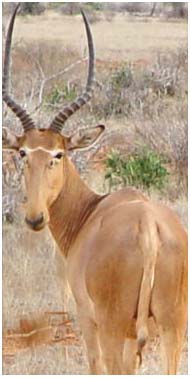
 Hirola2.jpg


Description
Size:
Head and body length: 120-205 cm
Shoulder Height: 88-134 cm
Tail Length: 10-60 cm
Weight: 68-115 kg

A slender antelope with a sandy brown coat which is paler below. The species has an elongated face with a slightly convex forehead. A white line, or chevron, passes from one eye to the other across the forehead, giving the HIROLA the appearance of wearing spectacles. The long, thin tail is white, as are the ears, which are tipped with black. The horns are well developed in both sexes; these are lyre-shaped and conspicuously ringed for most of their length, and when fully developed can reach lengths of over 70 cm.
ECOLOGY
Hirola are selective grazers. Their diet consists of short grasses, supplemented occasionally with forbs. They follow the progress of newly sprouting grasses on the savannah and grasslands, avoiding areas containing long grass. Most feeding activity takes place at dawn and dusk.
                                                                                                                     
The species has a harem-based mating system where dominant males defend a territory containing 7 or 8 females and their young. Small groups of bachelor males and yearlings also occur. Group size usually ranges from 5 to 40, although groups sometimes come together to form herds of several hundred individuals at certain times of the year. Males compete for access to females by posturing and fighting. Mating takes place at the start of the long rainy season (March-April), with most births occurring at the beginning of the short rainy season (October-November). Females give birth to a single young, generally away from the rest of the group. They spend up to two weeks alone with their calves, during which time both mother and calf are particularly vulnerable to predation from lions, cheetahs and hyenas. The young separate from the group at around one year of age to join a sub-group of yearlings. Females sexually mature at 2 to 3 years of age, while males do not mate until they can successfully compete with other dominant males, usually between 3 and 4 years of age. Lifespan in the wild is unknown, although this species lives for an average of ten years in captivity